A compliant preklad SmPC is a QRD-structure-preserving, clinically faithful national version of the approved English SmPC, delivered in submission-ready files. Regulators expect the numbering, tables and standard phrasing untouched, terminology locked to MedDRA conventions, and files ready within EMA’s early submission window around Day +5 after opinion. Miss any of that, and you’re looking at linguistic queries, rework, or worse.
What are the regulatory requirements for SmPC translation?
Let’s get one thing straight: an SmPC (Summary of Product Characteristics) isn’t a marketing document you can jazz up. It’s the legally binding reference text healthcare professionals rely on to prescribe safely, and it sits in a different regulatory tier from the Patient Information Leaflet (PIL), which is written for patients and allows a bit more explanatory breathing room. Confuse the two when translating, and you’ll end up with a PIL that reads like a pharmacology textbook or an SmPC that’s been softened for a lay audience. Neither works.
The EMA QRD templates set the mandatory section numbering, standardised phrasing for specific fields, and MedDRA frequency conventions that every language version has to follow, no exceptions. That template isn’t a suggestion. It’s the skeleton your Slovak, Czech, or Polish translation has to sit inside, headings, numbers and all.
Why so strict? Because the SmPC is a regulated legal document, not free prose. It gets reviewed by national competent authorities before it ever reaches a pharmacy shelf, and those reviewers are checking translation fidelity, not literary flair.
For Slovakia specifically, SÚKL’s MP 150-2026 methodological guideline spells out exactly what a “quality” national translation looks like. It covers faithful rendering of the source text, correct use of the QRD template, pagination and font rules, and which minor editorial adaptations are actually allowed (spoiler: not many).
Which procedures trigger a national translation requirement? Pretty much all of them, just on different clocks:
- Centralised procedure (CP): EMA coordinates translations of Annex I, II, III across all EU languages simultaneously.
- Mutual recognition procedure (MRP): the reference member state’s text gets translated for each concerned member state.
- Decentralised procedure (DCP): translations are prepared in parallel across all participating states from the start.
- Purely national procedures: translation requirements follow SÚKL’s own methodological rules directly.
During language control, reviewers are checking for fidelity to the English source, zero added or omitted clinical content, and adherence to font and pagination rules that keep the document consistent across all 24 EU languages, highlighting the advantages of mehrsprachige E-Learning Sicherheitstrainings in regulated sectors. It sounds bureaucratic because it is, but that rigidity is exactly what keeps a Slovak clinician and an Irish clinician reading the same clinical facts.
How does the QRD template structure your SmPC translation?
Here’s the bit that trips up even experienced medical translators: the QRD numbering isn’t decorative, it’s diagnostic. Section 4.6 is always fertility, pregnancy and lactation. Section 4.8 is always undesirable effects. Section 6.4 is always special precautions for storage. Renumber, reorder, or relabel any of that, and a regulator will flag it before they’ve even read your prose.
Certain sections carry prescriptive phrasing you simply cannot paraphrase. Section 4.8 needs frequency terms drawn from MedDRA conventions (very common, common, uncommon, and so on, tied to specific percentage bands), and Section 4.6 typically follows a fixed structural pattern the EMA’s own guidance on wording for sections like contraindications makes very clear.
Layout matters just as much as language. Watch for:
- Page footers and headers that must stay in the approved position across every language version.
- Font sizes calibrated for pagination consistency, especially in dosing and excipient tables.
- Dosing tables that must retain identical row and column structure, not just translated content.
- Excipient annex cross-references that need to point to the same section numbers in every language.
There’s a narrow lane for clarification. A brief explanatory parenthesis in a PIL, something that helps a patient understand a rare term, is generally fine. Adding clinical caveats, softening a warning, or inserting your own interpretation into an SmPC section is not. That’s a forbidden addition, full stop.
Pro Tip: Treat the QRD template as a legal framework rather than a style guide. If you’re tempted to “improve” a sentence for readability, ask whether that change alters clinical meaning or section structure first. If in doubt, flag it as a comment rather than silently editing.
What are the submission timelines for SmPC translations?
Timing catches out more projects than terminology does. For centrally authorised products, EMA’s practical translation guidance requires translated Annex I and III text to reach Member State contact points electronically shortly after the opinion. Member States then have a few weeks to send linguistic comments back, with final checks wrapped up soon after comments are received.
That’s a tight window, and it doesn’t leave room for a translator discovering ambiguity in the source text on Day +4.
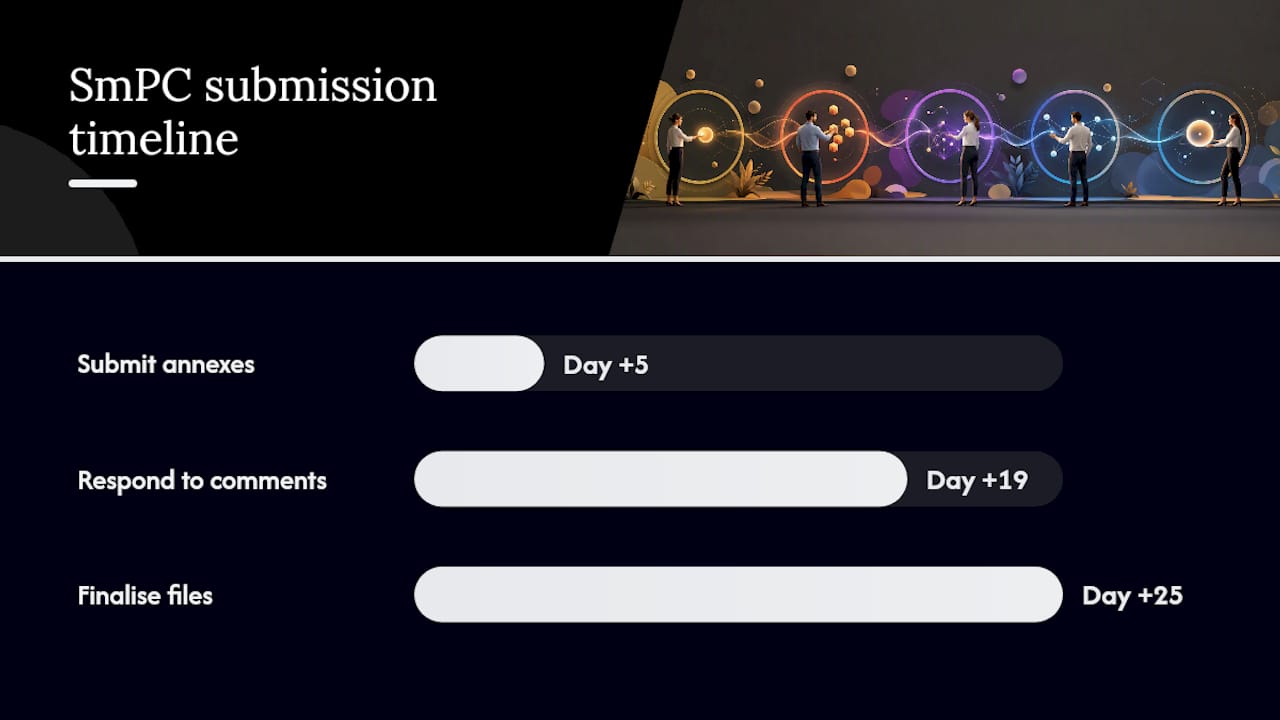
- Day +5: submit translated Annexes to all Member States simultaneously, formatted to QRD spec.
- Day +19: absorb and respond to national linguistic comments, which can range from a single typo flag to a substantive terminology query.
- Day +25: finalise clean and tracked versions incorporating agreed changes, ready for publication.
MRP, DCP, and purely national procedures run on their own delivery windows, and those can shift depending on whether you’re dealing with a Type IA or Type II variation. Smaller variations tend to move faster, but that just means your turnaround buffer needs to shrink too, not disappear.
File formats matter as much as dates. Reviewers expect a tracked-changes Word file for the comment stage, then a clean Word file and a clean PDF for final submission, alongside a completed QRD Form 2 flagging whether each Member State’s comment was implemented (or why it wasn’t).
Build in slack. Linguistic comments from 20+ Member States rarely arrive tidily, and a project plan with zero buffer for a contested terminology point is a plan that slips.
How do you run a submission-ready SmPC translation workflow?
Right, here’s where theory meets Tuesday morning. A solid SmPC translation workflow runs in five stages, and skipping any one of them is how “minor” errors end up in a regulatory query letter.
-
Intake and scoping. Confirm you have the final approved English text, not a draft still moving through committee. Identify the correct QRD template version and check for any national blue-box requirements SÚKL applies specifically to Slovak submissions.
-
Preparation. Build (or update) a glossary of approved phrasing before a single sentence gets translated. Map terminology against MedDRA conventions for adverse-event language, and set up a format-preserving CAT tool or layout engine so tables and numbering survive the translation process intact.
-
Translation. Assign a translator with genuine pharmaceutical or clinical background, not a generalist working from a dictionary. Where the source English is genuinely ambiguous, the right move is a documented comment flagging the ambiguity, never a silent editorial decision.
-
Review. A bilingual regulatory reviewer, ideally someone who’s read a fair few SmPCs before, checks the translation against the source line by line. This is also where you verify numbering, table structure, and excipient annex references haven’t drifted, using a tracked-changes workflow so every edit is visible and traceable.
-
Final QA and deliverables. Produce the clean Word file, the tracked-changes Word file, and the clean PDF. Complete QRD Form 2, documenting implementation or justified non-implementation of each Member State comment, and prepare mock-ups where the national procedure requires them.
Pro Tip: Keep a running glossary across every SmPC project for the same active substance, even across different marketing authorisation holders. Terminology drift between a product’s SmPC and its PIL, or between one variation and the next, is one of the most common reasons reviewers send back queries.
A quality assurance framework built around this five-stage structure, rather than a single translator working solo, is what actually keeps rework rates down. It also happens to be the difference between a translation memory that helps and one that quietly propagates the same mistake across twelve languages.
What happens when SmPC translation goes wrong?
Errors in SmPC translation aren’t cosmetic. They’re clinical risks wearing a linguistic disguise, and the consequences scale from mildly annoying to genuinely dangerous.
The usual suspects show up project after project:
- Renumbering drift, where a translator “tidies up” section order and breaks the QRD structure regulators expect to see in every language.
- Table reflow, where dosing or excipient tables lose row alignment during translation, sometimes shifting a decimal point into the wrong column.
- Wrong MedDRA frequency wording, swapping “common” for “uncommon” because the translator worked from sense rather than the fixed terminology band.
- Omitted excipient warnings, particularly for substances requiring specific patient warnings (lactose, sodium, certain colourants) that get quietly dropped in translation.
The regulatory consequence of any of these is usually a linguistic comment during the Day +19 review window, triggering a rework cycle and, depending on timing, a delay to market entry. That’s the mild end. The severe end is a safety incident: a mistranslated dosing instruction or a misstated active substance strength has driven real-world recalls, and research on medication labelling and translation impact points to exactly this link between labelling accuracy and patient safety outcomes.
Industry analyses of labelling and packaging failures, drawing on FDA recall data reviewed by IntuitionLabs, have tied labelling and packaging issues to a meaningful share of pharmaceutical recalls, a reminder that this risk isn’t theoretical even outside the EU regulatory context.
Mitigation isn’t complicated, but it does require discipline: format-preserving technology that stops tables and numbering drifting in the first place, a genuine dual-human review (not one tired translator checking their own work), and a habit of raising pre-submission linguistic queries the moment the English source is ambiguous, rather than guessing and hoping.
glocco®’s practical notes on SmPC translation projects
We’ve been doing this since 2014, and if there’s one thing that hasn’t changed, it’s this: regulatory translation punishes shortcuts. Glocco works across compliance-sensitive sectors, medical, legal, fintech, defence, and the discipline that keeps a legal contract watertight is the same discipline that keeps an SmPC submission-ready.
Our approach to SmPC work follows the operational logic laid out above: format-preservation baked in from the first file handoff, glossary management that carries across every language and every variation for a given product, MedDRA mapping done before translation starts (not patched in afterwards), and bilingual regulatory review as a fixed step, not an optional extra. Deliverables come as tracked-changes and clean Word files plus clean PDF, matched to whatever the specific procedure and Member State expects.
Turnaround depends on scope. A single-language variation update moves faster than a full multilingual CP rollout across two dozen languages, and we’ll scope both honestly rather than promise a one-size timeline.
Why the “just translate it accurately” advice misses the point
Here’s what most guidance on this topic gets wrong: it treats SmPC translation as a language problem when it’s actually a structural compliance problem wearing linguistic clothes. Accuracy matters, obviously, but a perfectly accurate translation that reflows a dosing table or renumbers Section 4.4 will still get flagged. The QRD template isn’t there to be respected in spirit, it’s there to be respected in form.
The conventional advice, “hire a good medical translator”, isn’t wrong, it’s incomplete. A good medical translator without a format-preserving workflow and a bilingual regulatory reviewer checking numbering and tables is still exposed to the exact renumbering and table-reflow errors that trigger linguistic queries. The skill that actually prevents rework is process discipline: glossary before translation, comments instead of silent edits, tracked changes at every review stage.
If you’re prioritising one thing first, prioritise the format-preservation workflow. Terminology can be corrected in a linguistic comment round. A regulator’s first impression of a document that doesn’t match the QRD structure is much harder to walk back.
— glocco®
How glocco® handles preklad SmPC projects
glocco® offers an integrated approach to regulatory translation, providing both translation and proofreading services. We handle the whole chain, regulatory-aware medical translators, format-preserving workflows that keep your QRD numbering and tables intact, and deliverables matched exactly to what EMA and SÚKL expect at submission (tracked Word, clean Word, clean PDF, QRD Form 2 support).
Our services are available on a project basis and through ongoing agreements, supporting pharmaceutical teams managing various translation needs. Clients in regulated sectors such as medical, legal, and fintech seek language services where compliance is a priority.
If you’ve got an SmPC translation coming up, our document translation guide for EU businesses is a solid starting point for scoping what “submission-ready” actually means for your specific procedure. Want a second opinion on an existing translation before you submit? A back-translation check is often the fastest way to catch a terminology slip before a regulator does. Get in touch for a quote, and we’ll scope the project honestly rather than promise a number before we’ve seen your files.
Where to check the rules yourself
Don’t take anyone’s word for it, including ours. Keep these close for every SmPC submission:
- EMA QRD templates and product information requirements
- EMA practical information on translations for referral procedures
- SÚKL MP 150-2026 methodological guideline
- EMA presentation on Section 4.3 contraindications wording
Bookmark them. Regulatory guidance shifts, and the version you read last year might not be the version your reviewer is checking against today.
This article is general information, not a substitute for advice from a qualified doctor. Consult a qualified healthcare professional about your own circumstances before acting on anything here.
Sources
- Product information: QRD templates (EMA)
- Practical information on translations for referral procedures (human) (EMA)
- Metodický pokyn na predkladanie kvalitných prekladov informácie o lieku (SÚKL MP 150-2026)
- PubMed: article on medication labelling/translation impact