Your KYC documents almost always need an official, certified translation, not a quick DIY job. Banks and fintechs typically want ID cards, passports, proof of address, and corporate registry extracts translated by a court-certified translator, sometimes bound to the original. Before you order anything, call the recipient, ask exactly what they’ll accept, and get your scans looking sharp first.
Which documents count as KYC documents (and which need certified translation)
Not every scan in your folder needs the same treatment. Personal identity documents like ID cards, passports, and residence permits usually need both sides captured, with the MRZ (that machine-readable strip at the bottom of a passport) fully legible. Miss that strip and you’re redoing the whole thing.
Proof of address documents, like utility bills or bank statements, generally need to be recent, typically within the last few months, though this varies by recipient. Corporate KYC is a different animal entirely. Expect requests for:
- Extract from the commercial register (business registration certificate)
- Articles of association or founding deeds
- Proof of beneficial ownership documentation
- Powers of attorney where someone signs on the company’s behalf
A standard translation might scrape by for internal reference, but the moment a bank, regulator, or fintech needs it for compliance filing, they’ll ask for a sworn translation, known in Slovak as “úradný preklad.” Court-certified translations carry legal weight; a bilingual colleague’s version does not, no matter how accurate it is.
What makes a translation legally acceptable for KYC purposes
Here’s the bit people skip and then wonder why their translation gets bounced back. An “úradný” (court-certified) translation isn’t just accurate language work. It’s a legal act. Only a translator formally appointed by the relevant justice authority can produce one, and their declaration usually confirms the translation matches the original exactly, alongside their official stamp and signature. The Ministry of Justice of the Slovak Republic sets out who qualifies for this role and the formal steps that follow.
Court-certified translations are often physically bound to the original document, or to a notarial copy of it, with a ribbon and seal that stops anyone swapping pages later. That’s not bureaucratic theatre. It’s what makes the document legally traceable.
Increasingly, you’ll see electronic versions too, sealed with a qualified electronic signature and time stamp instead of a physical ribbon. These carry the same legal standing when issued correctly, and they’re faster to send.
None of this happens in a vacuum. KYC itself is a regulatory obligation under Directive (EU) 2015/849, which is why banks can’t just accept “close enough.” And because you’re handing over passports and bank details, GDPR-appropriate handling, secure transfer, limited retention, anonymisation where possible, isn’t optional either.
Step-by-step process to prepare and order a KYC translation
Getting this right the first time saves you a second round of scanning, uploading, and waiting. Follow this order:
- Call the recipient first. Ask precisely whether they need a certified, sworn, or electronic translation, and whether binding to the original is required.
- Scan properly. Front and back of every ID document, full colour, high resolution, with the MRZ line fully readable. Save as JPG, PNG, or PDF.
- Specify certification level when ordering. Tell your translator exactly what the bank asked for, sworn, certified, or electronic, so they produce the right output first time.
- Attach supporting documents. If a power of attorney or corporate deed is involved, send it alongside the ID scans, not separately.
- Review on delivery. Check names match exactly, dates are current, and stamps or electronic seals are present before you submit anything.
Pro Tip: Keep a dated copy of every translation you’ve submitted, even rejected ones. If a bank queries something six months later, you’ll want the paper trail ready in seconds, not scrambling through old emails.
Electronic sworn translations and what your files need technically
Electronic sworn translations are increasingly common and, frankly, a lot less hassle than chasing a physical stamp across a city. They carry the same legal weight when issued with a proper qualified signature and time stamp.
The catch is technical, as automation for financial services requires precise document management for KYC compliance, detailed further in AI for Banks, Lenders & Financial Advisors | Compliant Automation. Automated KYC systems reject blurry, cropped, or poorly lit scans without mercy, and Lemonway’s KYC validation guidance confirms colour scans with readable MRZ lines, merged front-and-back pages in a single file, are what pass review consistently. Formats like JPG, PNG, and PDF are typically accepted, with automated checks often limiting file size to a few megabytes. Larger files usually still work, just via manual review instead.

If your first upload gets bounced, don’t panic, most systems allow multiple retries before flagging for human review.
How compliance teams verify translated KYC documents
Whoever’s checking your translation isn’t just glancing at it. They’re running through a mental (or literal) checklist, and knowing it in advance means fewer surprises:
- Is every page fully legible, including the MRZ strip?
- Does the translated name match the ID exactly, including diacritics and transliteration choices?
- Is the underlying document still valid, not expired?
- Does the translator’s statement, stamp, or electronic seal actually appear?
- If a notarial copy or binding was required, is it there?
- For electronic files, is there a verifiable timestamp or provenance trail?
Names trip people up more than anything else. A translated “Ján” that becomes “Jan” without explanation can flag as a mismatch in automated systems, so a short translator’s note on transliteration choices genuinely helps avoid false rejections.
Typical turnaround times and pricing shapes for KYC translations
Pricing for KYC translation work usually follows one of three shapes: per word, per page, or a flat fee that bundles in the certification itself. Certification and notarial binding tend to add a fixed surcharge on top of the base translation cost, and that’s before you factor in express delivery.
Standard turnaround for a straightforward ID or proof of address document is often measured in a couple of working days; express services exist but cost more, particularly if a notarial appointment needs to be squeezed in at short notice. Apostilles, if your document needs one for cross-border use, add both time and cost, since they typically involve a separate government office.
The practical way to avoid emergency pricing? Order early. If you know a KYC deadline is coming, don’t wait until three days before to discover your passport translation needs a notary’s signature too.
How glocco® handles KYC translations
We work across fintech, legal, and banking sectors often enough to know exactly what “compliance-ready” actually needs to look like on paper, not just in theory. Our translators handle the sensitive stuff, IDs, proof of ownership, corporate deeds, with GDPR-safe processes built in, including anonymisation of personal data where a client needs sensitive fields redacted before wider circulation.
Every delivery is built to be audit-ready: clear translator statements, proper stamps or electronic seals, and documentation trails that hold up if a regulator asks questions later. Need an electronic seal instead of a physical one? Just ask when you place your order.
What we need from you: clear, high-resolution scans (front and back, please), the exact certification level your recipient wants, and your deadline. We’ll take it from there.
Common errors that get KYC translations rejected
Most rejections aren’t dramatic. They’re small, avoidable things that pile up.
Blurry or partial scans top the list. A passport photographed at an angle, with the MRZ strip cut off or glared over, will bounce straight back regardless of translation quality. The translation can be flawless and it still won’t matter if the source document isn’t legible.
Mismatched names cause more headaches than people expect. Diacritics dropped, name order swapped, or a middle name omitted, any of these can trigger an automated flag even when the translation is technically correct. A translator’s note explaining transliteration choices heads this off before it becomes a problem.
Missing certification is another common trap. Ordering a “standard” translation when the recipient actually wanted a sworn one wastes everyone’s time and money. Always confirm the exact wording the recipient uses, “certified,” “sworn,” “notarised,” because these terms aren’t always interchangeable across institutions.
Expired source documents slip through too. A proof of address from eight months ago, or an ID that’s lapsed, gets rejected regardless of how good the translation is.
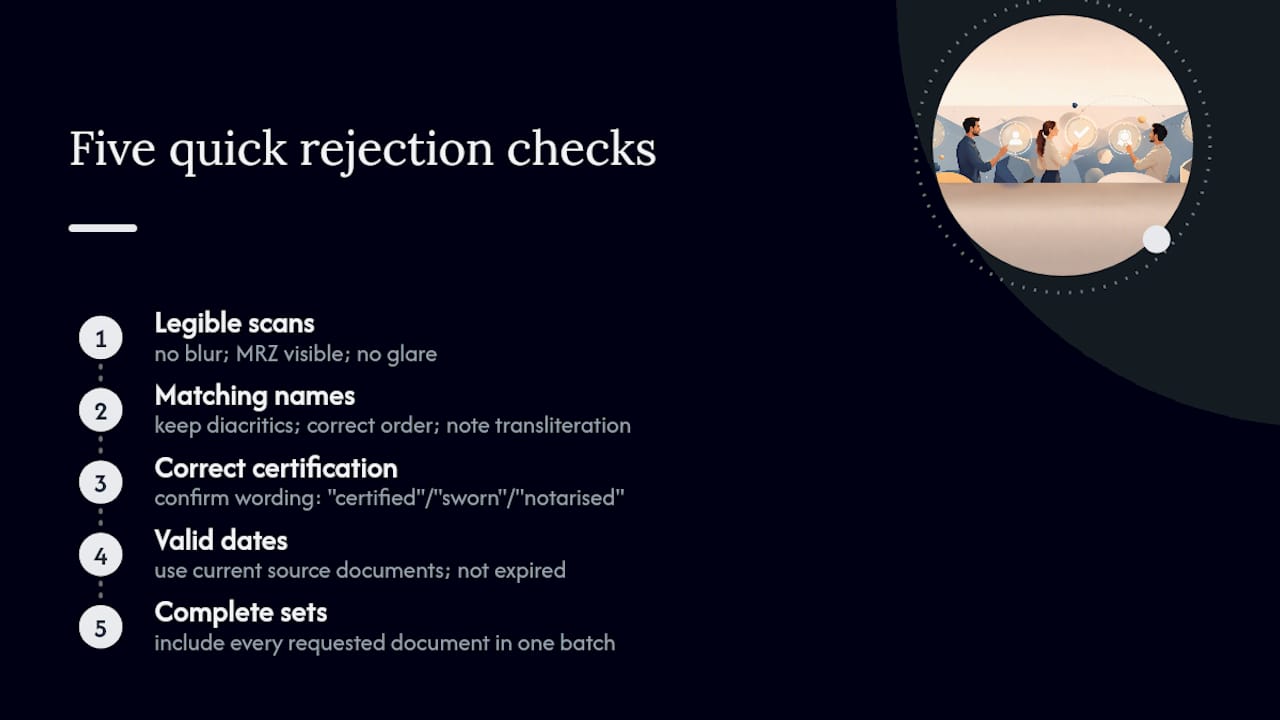
Incomplete document sets round it off. Sending a passport translation without the accompanying power of attorney, when both were requested, means a second submission round. Batch everything the recipient asked for into one delivery.
Choosing a translation provider for legal and financial documents
Not every translation agency handles KYC work well, and the gap between “translates well” and “translates for regulated finance” is bigger than it looks.
Look for a provider with genuine experience in fintech, legal, or banking sectors specifically, not just general document work. Ask directly whether their translators are court-certified where that’s required, and whether they can produce electronic sealed translations if your recipient prefers that route. A document translation guide for EU businesses is worth reading if you want a fuller picture of what “certification” actually covers across different jurisdictions.
Check turnaround honesty too. A provider promising same-day sworn translation for a complex corporate document set is either exceptionally well resourced or cutting corners somewhere. Ask about their security process for handling sensitive data, because your passport scan shouldn’t be sitting in an unencrypted inbox for a week.
Country-specific variations in acceptance criteria
Here’s where a lot of businesses get caught out: what one country’s bank accepts, another’s regulator won’t touch. Some jurisdictions insist on a sworn translation physically bound to a notarial copy of the original, others accept a qualified electronic seal without any paper at all. A few recognise translations certified in a different EU country outright; others want a local court-certified translator specifically, regardless of where the original certification happened.
This isn’t a case of one country being stricter and another being lax. It reflects genuinely different legal traditions around what “official” means. Some justice systems tie certification tightly to a national register of appointed translators, meaning a perfectly valid sworn translation from a neighbouring country simply doesn’t carry the same status locally.
The only reliable fix is asking the specific recipient, every time, even if you’ve done business with a similar institution elsewhere before. Assuming acceptance criteria transfer across borders is one of the most common (and costly) mistakes in this whole process.
Sending sensitive KYC documents securely
You’re handing over passport numbers, addresses, and sometimes ownership structures, so how you send that matters as much as the translation itself.
Avoid plain email attachments where possible. Encrypted file transfer portals or secure client dashboards are far safer, and a decent translation provider should offer one rather than asking you to email a passport scan as a PDF attachment. Password-protect anything you must send by email, and share the password through a separate channel, never in the same message.
On the return leg, ask how the finished translation will be delivered and whether it’s similarly encrypted. Ask, too, how long your documents will be retained afterwards, and whether anonymisation or redaction is available if you’re only sharing the file with a limited internal audience.
The uncomfortable truth about “just get it translated”
Most advice on this topic treats translation as the whole job. It isn’t. The translation is often the easy part; the certification, formatting, and scan quality are where things actually fall apart.
The conventional wisdom, find a good translator, get it done, undersells how much of the rejection risk sits entirely outside the translation itself. A perfect sworn translation of a blurry passport scan is still a rejected passport scan. Compliance teams aren’t grading language quality first; they’re checking legibility, name matching, and provenance, then the translation.
If there’s one thing worth prioritising above all else, it’s confirming exact requirements with the recipient before you order anything. Not “certified translation,” generically, but their specific wording, their specific format expectations, their specific stance on electronic seals. Skip that step and you risk paying twice for the same document.
— glocco®
Ready to get your KYC documents translated properly?
Using a professional language service provider is the straightforward route through this whole process, avoiding guesswork about certification levels and relying on scan quality that passes automated checks. Such providers often handle compliance-sensitive documents across fintech, legal, and banking sectors, gaining experience in typical requirements from banks and fintechs.
When you get in touch, provide document types, languages involved, certification needs, and your deadline to receive an accurate quote. Head to our document translation guide for EU businesses to see exactly how the process works, or send your documents straight through and we’ll come back to you with a clear quote and timeline.
This article is general information, not a substitute for advice from a qualified financial advisor. Consult a qualified financial professional about your own circumstances before acting on anything here.