


Managing contracts across languages is genuinely hard. A mistranslated liability clause or a missing governing language provision can unravel months of negotiation and expose your organisation to real legal risk. The good news? The right multilingual contracts workflow, backed by AI trained on legal data, turns that risk into a repeatable, auditable process. For UK legal teams in 2026, the leading options are Sirion AI, Youtrust, DocJuris, DocuSign CLM, and Sign Made Easy. Each takes a different approach, and the differences matter far more than most buyers realise.
AI-integrated CLM systems process multilingual contracts significantly faster than manual review, cutting translation turnaround from days to minutes while reducing compliance failures. The tools below reflect that shift.
| Tool | Multilingual language support | Legal compliance | Workflow automation | AI capabilities | Best for |
|---|---|---|---|---|---|
| Sirion AI | many languages | Multi-jurisdiction, explainable AI | Full CLM lifecycle | AI Extraction Agent, agentic RAG | Large enterprises, complex portfolios |
| Youtrust | Broad multilingual support | European frameworks, AI nuance | End-to-end CLM | Deep AI legal extraction | Legal teams needing compliance depth |
| DocJuris | Multi-language upload | SOC 2 Type II certified | Playbook-driven redlining | Limited deep AI understanding | Teams prioritising playbook flexibility |
| DocuSign CLM | multiple languages, English-first | Global operations | Integrated eSignature + CLM | Moderate AI features | Integrated eSignature and CLM globally |
| DocuSign | multiple languages | Global eSignature standard | eSignature workflows | Basic AI | Reliable eSignature with some multilingual features |
| Sign Made Easy | Multiple languages | Standard compliance | Simple eSignature workflows | Basic | SMEs needing straightforward eSignature |
| Sirion | many languages | Multi-jurisdiction | Full CLM lifecycle | Explainable AI | Enterprise multilingual contract management |
Which tools best support multilingual contract workflows for UK legal teams?
The gap between tools that translate and tools that understand is where most buying decisions go wrong. Here is how the main contenders actually compare.
Sirion AI is the most capable platform for organisations managing contracts at scale across languages. Enterprises report significantly faster contract review cycles and quicker negotiation across all supported languages, with AI flagging substantially more issues during redlining than manual review. Its AI Extraction Agent processes a very large number of documents daily across many languages, applying models tuned to legal nuance rather than general translation. Named a Leader in Gartner’s 2024 Magic Quadrant for CLM for the third consecutive year, Sirion manages contracts worth a very large value globally. For UK legal teams with cross-border portfolios spanning European, Asian, or Middle Eastern counterparties, that depth of language intelligence is difficult to match.

Youtrust targets legal teams that need genuine AI depth rather than surface-level translation. Its strength lies in extracting legal nuances across jurisdictions, making it well suited to compliance-heavy environments where a mistranslated indemnity clause carries real financial consequence. It covers European legal frameworks specifically, which matters for UK organisations still navigating post-Brexit contract structures with EU counterparties.
DocJuris takes a playbook-first approach. Teams upload contracts in any language and run them against playbooks written in any language, which gives flexibility without requiring deep AI comprehension of each language’s legal context. SOC 2 Type II certification addresses security concerns, but the underlying AI still struggles with the nuances that determine whether a clause is enforceable in a given jurisdiction.
- DocuSign and DocuSign CLM offer the most familiar eSignature infrastructure globally, with CLM adding contract lifecycle management on top. The honest limitation: both platforms default to English-first workflows. Genuine Parts Company noted that DocuSign CLM helped their global teams “speak the same language now when it comes to contracts,” but that standardisation often means adapting non-English contracts to English processes rather than the reverse.
- Sign Made Easy suits SMEs that need multilingual eSignature without the complexity or cost of enterprise CLM. It covers the essentials and keeps the interface accessible, but it is not designed for organisations managing hundreds of contracts across multiple jurisdictions simultaneously.
Pro Tip: Before committing to any platform, run a pilot with ten to fifteen contracts in your most critical non-English language. The difference between a tool that translates and one that understands legal context becomes obvious very quickly.
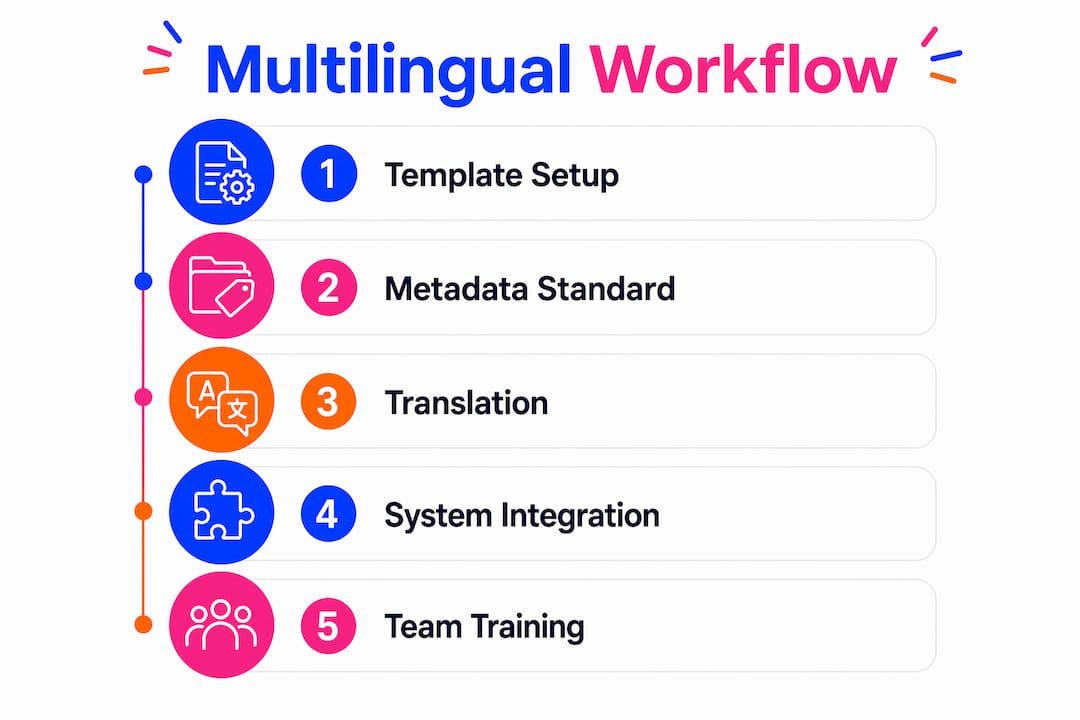
How do you design and manage a multilingual contract workflow?
Getting the workflow right matters as much as choosing the right tool. A well-designed process reduces errors, speeds up review, and keeps your contracts enforceable across jurisdictions.
Start with modular global templates
Effective global contract templates use modular building blocks, separating universal clauses from locally adapted addenda. Build a core library of neutral, non-idiomatic clauses covering governing law, termination, dispute resolution, and confidentiality. Then attach jurisdiction-specific addenda rather than rewriting the whole contract for each market. This approach keeps the master template manageable and reduces the risk of inconsistencies creeping in during localisation.

Over-customising global templates creates unmanageable complexity fast. A core library with modular localised addenda is the established best practice for a reason.
Standardise metadata before you localise
Standardise metadata such as renewal dates, governing law fields, and counterparty identifiers before any translation begins. Without this step, your analytics become fragmented across language versions and you lose the ability to report reliably on contract status across your portfolio. Tag every contract with consistent field names regardless of the language the document is written in.
Use AI for extraction, humans for legal review
AI trained on legal data handles clause extraction, risk flagging, and metadata tagging well. It does not replace a qualified lawyer reviewing a high-stakes indemnity clause in an unfamiliar jurisdiction. The right governance structure defines clearly when AI-assisted review is sufficient and when native legal review is required. Build that decision tree into your workflow from day one, not as an afterthought.
- Map each contract type to a risk tier (high, medium, low).
- Assign AI-only review to low-risk, standard-form contracts.
- Require human legal review for high-risk or novel clause structures.
- Create escalation paths for contracts that fall outside the AI’s training data.
- Log every review decision in the audit trail for compliance purposes.
Integrate with existing systems
A multilingual workflow that sits outside your existing matter management or ERP system creates data silos. Most enterprise CLM platforms, including Sirion AI and DocuSign CLM, offer API integrations with common legal and business systems. Map those integration points before implementation, not during it.
Train your teams properly
Structured change management reduces resistance and improves adoption outcomes. Run pilot projects on high-visibility contracts in your most critical languages. Involve regional legal teams early so they trust the system’s output in their language. Frameworks like ADKAR give you a repeatable model for managing the human side of the transition. The technology is only as effective as the people using it.
Pro Tip: Invest in legal terminology translation workflows before going live. Consistent terminology across all language versions of a contract is the single biggest factor in preventing interpretive disputes later.
What are the most common pitfalls in multilingual contract management?
Poor contract management regularly costs companies a significant share of annual revenues. In multilingual environments, the risks compound because errors hide in translation layers that reviewers may not catch.
Statistic to know: Poor contract management regularly costs organisations approximately 9% of annual revenues, according to analysis of CLM platform data. Multilingual contracts amplify that risk when translation quality is inconsistent.
The most frequent problems legal teams encounter:
- No governing language clause. Without one, courts must decide which language version controls in a dispute. That uncertainty is avoidable and expensive.
- Governing language clause without conflict resolution language. A governing language clause is ineffective unless it explicitly states that the governing language version prevails and that all other translations serve as reference only. A clause that simply names a language without establishing hierarchy leaves the door open to interpretive disputes.
- Generic translation tools applied to legal text. General-purpose machine translation misses the legal nuances that differ between jurisdictions. A “limitation of liability” clause translated literally into German or French may carry entirely different legal weight than the English original intended.
- Inconsistent terminology across versions. If “termination for convenience” appears as three different phrases across the English, French, and German versions of the same contract, you have created ambiguity that a counterparty’s lawyer will exploit.
- Outdated localised addenda. Local law changes. A jurisdiction-specific addendum written in 2022 may no longer reflect current regulatory requirements. Build a review cycle into your template governance.
- Missing audit trails on translated versions. If you cannot prove which version of a contract was signed, by whom, and when, you have an enforceability problem regardless of translation quality.
For UK teams specifically, post-Brexit contract structures with EU counterparties require particular attention to governing law and jurisdiction clauses. English law remains widely chosen for international commercial contracts, but that choice must be explicit and correctly drafted. The role of translation in legal compliance extends beyond accuracy to ensuring the translated version does not inadvertently alter the legal effect of the original.
How glocco® approaches multilingual contract localisation
glocco® has worked across legal, fintech, and public sector contracts since 2014, combining AI-assisted translation with human legal linguists who understand the difference between a translated clause and an enforceable one. The approach is not to replace legal review but to make it faster and more reliable across languages.
Key differentiators in glocco®’s workflow:
- Legal-grade AI combined with human review. AI handles volume and speed; qualified legal translators handle nuance and jurisdiction-specific accuracy. Neither works as well alone.
- Metadata standardisation as a first step. Every project begins with aligning field names, date formats, and governing law references before any translation starts, preventing the fragmented analytics problem that plagues multilingual contract portfolios.
- EU and UK regulatory competence. glocco® covers European legal frameworks with specific attention to post-Brexit UK requirements, including the interaction between English law contracts and EU counterparty jurisdictions.
- Modular template support. glocco® helps legal teams build and maintain modular contract libraries with localised addenda, reducing the cost and time of adapting contracts for new markets.
- Audit-ready outputs. Every translated document comes with a clear version history and translator certification, supporting the audit trail requirements of UK-regulated industries.
Pro Tip: Blending AI tools for legal translation with human expertise is not a compromise. It is the only approach that delivers both the speed your commercial teams need and the accuracy your legal teams require.
The 2026 legal translation trends point clearly toward AI-assisted workflows with human oversight as the standard, not the exception. Teams that build that hybrid model now will process contracts faster, with fewer disputes, than those still relying on either pure manual review or generic machine translation.
Why does multilingual support matter so much in contracts?
A contract written in one language and signed by parties operating in another is a dispute waiting to happen. The problem is not just translation accuracy. It is the assumption that legal concepts transfer cleanly between languages and legal systems, and they often do not.
Consider indemnity clauses. In English law, an indemnity creates a primary obligation to pay. In many civil law systems, the equivalent concept operates differently, with different triggers and different remedies. A word-for-word translation of an English indemnity clause into French or German may produce a clause that looks correct but functions differently in a French or German court. That gap between appearance and legal effect is where multilingual contract risk lives.
For UK organisations, the stakes are particularly high right now. Post-Brexit trading relationships require contracts that work under both English law and the law of EU member states. Supply chains that once operated under harmonised EU frameworks now require explicit governing law choices, jurisdiction clauses, and in many cases, parallel versions of the same contract in different languages. Getting multilingual legal communication right is no longer a nice-to-have for UK legal teams with European counterparties. It is a commercial necessity.
The automation of B2B workflows in professional services has accelerated this shift, with legal teams expected to process more contracts, faster, across more jurisdictions than ever before. Multilingual CLM platforms that treat every language with equal sophistication turn that pressure into a manageable process rather than a recurring crisis.
Why multilingual contract workflows give UK legal teams a competitive edge
The legal teams winning global mandates in 2026 are not necessarily the largest. They are the ones that can move quickly and confidently across languages and jurisdictions without losing accuracy or compliance.
- Faster deal cycles: 60% faster contract reviews across languages translate directly into accelerated deal closure, particularly in competitive procurement processes where response time matters.
- Reduced legal risk: AI that identifies substantially more redlining issues than manual review catches problems before they become disputes, not after.
- Operational efficiency: automated clause extraction and metadata tagging free legal teams from administrative work, letting them focus on the decisions that actually require legal judgement.
- Competitive positioning: organisations that can negotiate and execute contracts in a counterparty’s language, with full legal accuracy, signal a level of professionalism that English-only competitors cannot match.
- Regulatory confidence: structured audit trails and version control across language versions satisfy the compliance requirements of UK-regulated industries, from financial services to healthcare procurement.
The integration of agentic AI, where AI systems autonomously identify jurisdictional requirements and suggest negotiation strategies, is already live in platforms like Sirion AI. UK legal teams that build multilingual workflow capability now are positioning themselves for a market where language fluency, backed by technology, is a genuine differentiator.
glocco® makes multilingual contract localisation practical
If the tools above handle the CLM and eSignature layer, glocco® handles the language layer that sits underneath all of them. Getting contracts right across languages requires more than software. It requires people who understand both the legal system and the language, and a process that connects translation quality to contract enforceability.
glocco® offers language localisation services built specifically for legal and regulated industries, covering translation, review, and certification across European, Middle Eastern, and Asian languages. For UK legal teams managing cross-border contracts, that means faster turnaround, legally accurate outputs, and audit-ready documentation that holds up under scrutiny.
Whether you are building a global contract template library, localising existing agreements for new markets, or setting up a repeatable multilingual legal support process, glocco® works alongside your legal team rather than replacing it. The result is contracts that are accurate, compliant, and enforceable, in every language you need.


