


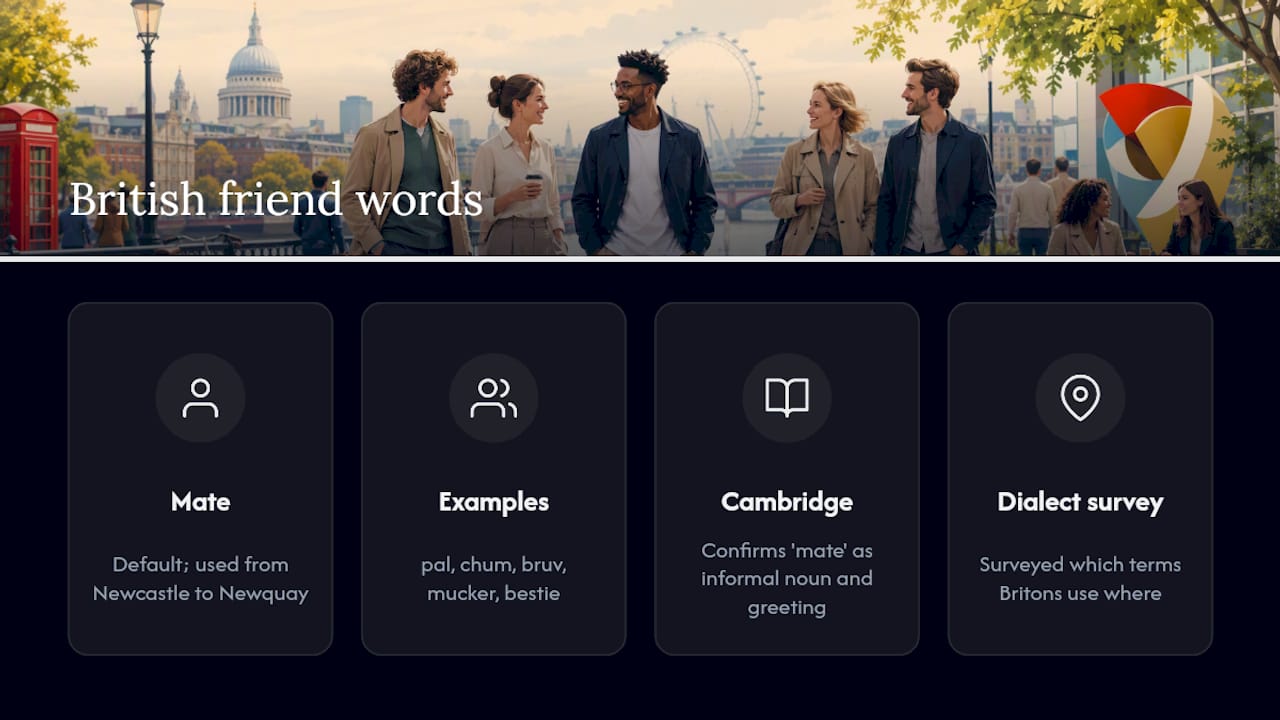
Use “mate” when in doubt. It’s the default British word for friend, works with strangers and best friends alike, and won’t sound odd anywhere from Newcastle to Newquay. Beyond that, British English has a wide range of options including pal, chum, bruv, mucker, bestie, and many regional variants used locally. The Cambridge Dictionary confirms “mate” as a standard informal noun and greeting, while the Dialect and Heritage Project has actually surveyed which terms Britons use where. At glocco®, we spend our days worrying about exactly this kind of nuance, so consider this your cheat sheet.
British words for friend: the annotated list
Right, here’s the core list. Each one comes with a meaning, a tone tag, and a sentence so you can hear how it actually sounds.
- Mate — the all-purpose default. “Cheers, mate, I owe you one.” Tone: informal, gender-neutral, used everywhere from Land’s End to John o’ Groats.
- Pal — friendly, slightly old-fashioned, works fine on its own or as “pally” (getting friendly fast). “Me and Dave have been pals since school.” Tone: informal, mildly dated.
- Chum — has a whiff of Enid Blyton about it, but still gets used, often jokingly. “Long time no see, old chum!” Tone: old-fashioned, affectionate, often playful.
- Bruv (or bruvva) — London and South East slang, short for “brother,” used mostly between men. “You alright, bruv?” Tone: informal, regional, usually male-to-male.
- Mucker — Northern English and Irish slang for a close mate. “He’s me best mucker, that lad.” Tone: informal, regional, fairly niche now.
- Bestie — your closest friend, imported from American teen speak but fully naturalised. “She’s my bestie, we tell each other everything.” Tone: informal, affectionate, often used by younger speakers.
- Bro — American in origin, now everywhere in the UK among younger men. “Cheers, bro, appreciate it.” Tone: informal, gender-specific, casual.
- Lad — refers to a male friend or friend group, especially in a laddish, blokey context. “Off out with the lads tonight.” Tone: informal, male, social.
- Ace — mostly Northern, can mean friend or just “great,” context does the work. “He’s a proper ace, that one.” Tone: informal, regional, slightly dated.
- Buddy — another American import, common in casual UK speech, especially with kids or between men. “Alright, buddy, how’s it going?” Tone: informal, casual, gender-neutral.
- Fam — originally London multicultural slang for close friends or family, now widespread among younger speakers. “Safe, fam, catch you later.” Tone: informal, youth slang, regional roots.
Note the gendered patterns: “bruv” and “lad” skew male, while “mate,” “buddy,” and “bestie” work for anyone. Context does most of the heavy lifting here.
Regional British slang for friend across the UK
Some friend-words never leave their home turf, and using them elsewhere can mark you out as an outsider trying too hard. The Dialect and Heritage Project’s survey work backs this up: regional terms like “pet” and “bab” are still very much alive in their own patches.
- Pet — North East England, Newcastle especially. “Y’alright, pet?” Still current, warm rather than romantic.
- Bab — Birmingham and the Black Country. “Cheers, bab, that’s kind of you.” Still heard daily, gender-neutral.
- Marra — Cumbria and parts of the North East. “He’s me marra from way back.” Fairly local, slightly old-fashioned outside its region.
- Cocker — Lancashire and parts of the North West. “Now then, cocker, how’ve you been?” Old-fashioned but still recognised.
- Hen — Scotland, particularly Glasgow. “You alright there, hen?” Very current, typically used towards women.
- Duck — East Midlands, Derby and Nottingham. “Ta very much, duck.” Still common, works across genders.
Try one of these outside its home region and you’ll likely get a puzzled smile rather than offence, but it won’t land the way it does locally.
How and when to use British friend-words properly
Getting the word right matters less than getting the moment right. Here’s the quick version:
- Use “mate” as a greeting (“Alright, mate?”) or as a noun (“he’s my mate”) — it flexes both ways.
- Match formality to the setting: save “bruv,” “fam,” and “lad” for genuinely casual chat, not client emails.
- Don’t borrow a hyper-local term like “marra” or “cocker” unless you’re actually from that region or repeating it back to a local who used it first.
- Treat most of these as gender-neutral by default, except “bruv” and “lad,” which lean male in everyday use.
“Mate” means friend in British English, full stop. But cross the Atlantic and things get murkier. As Language Log notes, the word can carry a romantic or sexual undertone in some American contexts, which is exactly the kind of gap that trips up scripts, subtitles, and marketing copy translated without local checking.
That single-word difference is why “mate” in a UK advert and “mate” in a US-facing one can land completely differently.
Terms of endearment that double as friend-words
Some words slide between “just friends” and “something more” depending entirely on who’s saying them.
- Love — friendly in shops and among strangers, mildly romantic between partners. Tone: ambiguous.
- Hun — common among female friends, but also used romantically. Tone: ambiguous.
- Duck — almost always platonic in the East Midlands. Tone: friendly.
- Darling — theatrical and platonic among some social circles, romantic elsewhere. Tone: ambiguous.
- Pet — warm and platonic in the North East, rarely romantic. Tone: friendly.
As the British Council explains, context, relationship, and region decide which side of the line a word falls on. A shopkeeper calling you “love” means nothing more than politeness; a partner using the same word means something else entirely.
Quick dos and don’ts for using British slang
- Do default to “mate” when unsure. It’s safe almost everywhere.
- Do match the register: casual word for casual chat, not for a job interview.
- Don’t use hyper-local terms like “marra” or “bab” outside their region.
- Don’t assume “bruv” or “lad” works for mixed-gender groups.
- Do listen first. If locals say “duck” or “hen,” it’s safe to mirror them.
- Don’t translate “mate” literally into other languages expecting the same tone.
Pro Tip: Before using a regional term in writing (an email, a caption, a script), say it out loud in context first. If it sounds like you’re doing an impression rather than speaking naturally, swap it for “mate” or “pal” instead.
glocco®’s localisation tip: choosing the right friendly tone
Getting British tone right isn’t about picking the funniest slang word. It’s about matching register to audience, every time.
- Check who’s actually reading: young, casual audiences tolerate “fam” or “bruv”; corporate audiences don’t.
- Test regional terms with someone from that actual region, not a general UK proofreader.
- Watch for false friends like “mate,” which shifts meaning across English dialects.
- Keep formal and informal registers separate within the same piece of copy.
- When subtitling or dubbing, flag ambiguous terms of endearment for the translator, not just the words themselves.
Before: “Hey buddy, check this out!” After (UK, informal): “Alright mate, check this out!” Small swap, completely different regional feel.
glocco® handles exactly this kind of tonal calibration across 76 languages for e-commerce, gaming, and marketing teams who can’t afford to get “mate” wrong in a global campaign.
Why does British English have so many words for friend?
Britain’s a small island with a stubbornly local streak. Every region held onto its own dialect through industrial towns, ports, and pit villages, and friend-words became a badge of belonging. Knowing which one fits where isn’t just trivia. It’s the difference between sounding like a local and sounding like you’ve swotted up from a phrasebook.

Get your British tone right, every time
Here’s the thing: nailing “mate” versus “bruv” versus “pet” in a blog post is one thing. Getting it right across a website, an app, and a customer support script for UK shoppers is a different job entirely, and it’s exactly what glocco® does day in, day out. We don’t just translate words, we localise tone, so “buddy” becomes “mate” and nobody’s client-facing copy accidentally sounds like it’s flirting with strangers. If you’re prepping content for a UK audience, grab our language localisation checklist and see exactly what to check before you hit publish. It’s free, it’s practical, and it’ll save you from a dodgy “mate” moment down the line.
Sources
- North and South – The Dialect and Heritage Project
- mate | Cambridge Dictionary
- Terms of endearment: a deep dive into the vocabulary of the heart | British Council
- Language Log — on ‘mate’ and cross-cultural nuance


