


Interpreters in crisis response are the difference between a managed emergency and a catastrophic communication failure. When a cyclone strikes, a mass casualty incident unfolds, or a refugee crisis escalates, language barriers do not pause for responders to catch up. The role of interpreters in crisis response goes far beyond word-for-word translation. Qualified interpreters carry cultural context, maintain emotional neutrality, and keep information flowing accurately when lives depend on it. This guide gives crisis management professionals the practical framework to integrate interpreters effectively, from the first call to the final debrief.
How do interpreters enhance trust and compliance in emergency aid distribution?
Trust in interpreters is the foundation of effective aid distribution in multilingual crisis settings. Without it, beneficiaries withhold information, ignore instructions, and disengage from relief programmes entirely. That is not a communication problem. It is an operational failure.
Research following the march 2023 cyclone in Malawi confirmed that interpreter-facilitated trust directly increases beneficiary compliance and overall relief success. The implication is clear: organisations that invest in qualified interpreters do not just communicate better, they distribute aid more effectively. Cultural competence is a core part of this. An interpreter who understands local norms can flag when a message will land badly, before it causes harm.
Médecins Sans Frontières describes qualified interpreters as providing a fundamental human connection in crisis medical contexts. In Tanzania, MSF interpreters transformed clinical environments from frightening and silent into comprehensible, dignified spaces where informed consent became possible. That is the standard every crisis organisation should aim for.
- Interpreters reduce miscommunication that leads to aid refusal or non-compliance
- Cultural competence prevents messages from being misread or causing offence
- Interpreter-mediated dialogue builds institutional trust with affected communities
- Professional interpreters uphold dignity, which matters as much as accuracy
Pro Tip: Never use community leaders or local volunteers as your primary interpreters unless they are trained. Their authority within the community can distort the message and compromise neutrality.
What are best practices for integrating interpreters in crisis communication workflows?
Early interpreter involvement stabilises panicked individuals and improves responder situational awareness. Waiting until communication has already broken down costs time and accuracy. The interpreter needs context to do the job well, and that context comes from being present from the start.
A layered access model is the most reliable approach for crisis organisations. Combining over-the-phone interpretation (OPI), video remote interpreting (VRI), and in-person interpretation addresses varying emergency demands efficiently. Each mode serves a different scenario.
- Over-the-phone interpretation (OPI): Deploy immediately for first contact, triage calls, and situations where speed matters more than visual cues.
- Video remote interpreting (VRI): Use when facial expression and non-verbal communication are critical, such as mental health assessments or consent conversations.
- In-person interpretation: Reserve for prolonged incidents, complex negotiations, or situations requiring sustained community engagement.
Briefing interpreters before deployment is non-negotiable. Share the incident type, key terminology, and any known sensitivities. This is not bureaucracy. It is the difference between an interpreter who performs and one who guesses. For guidance on setting up remote interpreting within your response workflow, the technical groundwork matters as much as the human element.
Pro Tip: For prolonged incidents lasting more than four hours, rotate interpreters to prevent fatigue-related errors. Cognitive load in crisis interpreting is significant, and accuracy drops sharply when interpreters are exhausted.

What challenges and risks arise from improper interpreter use in emergencies?
Ad-hoc interpreting by family members or bystanders introduces critical communication risks in emergencies. Emotional bias, inaccurate symptom relay, and deliberate or unconscious omission all compromise life-or-death decisions. A parent interpreting for an injured child is not neutral. A bystander interpreting for a stranger may not understand the medical or legal terminology involved.
The table below shows the key differences between interpreter types and the risks each carries.
| Interpreter type | Accuracy | Neutrality | Cultural competence | Risk level |
|---|---|---|---|---|
| Trained professional | High | Maintained | Verified | Low |
| Trained volunteer | Moderate | Generally maintained | Variable | Moderate |
| Bilingual staff member | Variable | Compromised by role | Variable | Moderate to high |
| Family member or bystander | Low | Not maintained | Unpredictable | High |
Untrained interpreters introduce emotional bias and errors that affect outcome quality. Trained interpreters maintain neutrality and accuracy under stress. That distinction is not a preference. It is a professional standard.
- Vetting interpreters before a crisis, not during one, is the only reliable approach
- Trained interpreters understand when to flag a communication breakdown rather than paper over it
- On-demand telephone and British Sign Language (BSL) video interpreting services reduce the temptation to use untrained alternatives
- Certified interpreters bring documented competence, which matters when decisions are later reviewed or challenged
How can organisations prepare and optimise interpreter use for crisis response?
Language access is core infrastructure in emergency response, not an optional add-on. Organisations that treat it as an afterthought discover the gap at the worst possible moment. Pre-training responders in interpreter connection protocols is the single most effective preparation step.
The table below outlines an operational readiness framework for interpreter integration.
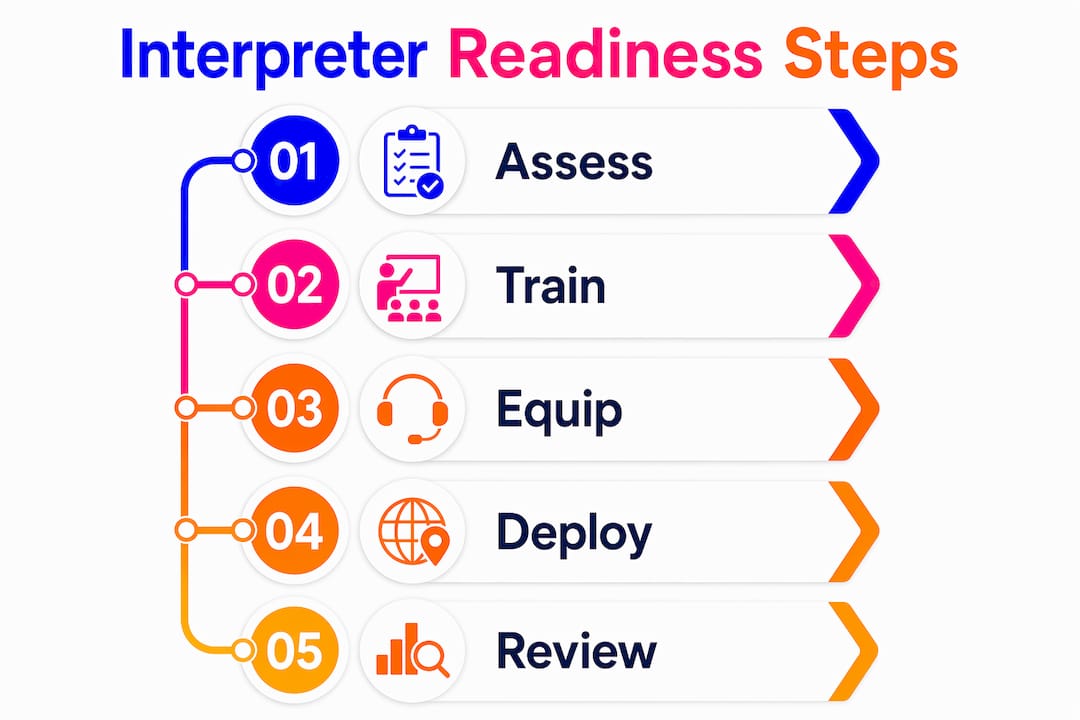
| Readiness area | Action required | Outcome |
|---|---|---|
| Responder training | Train all frontline staff to connect with interpreters within two minutes | Faster language access at first contact |
| Technology integration | Deploy OPI and VRI platforms with tested protocols | No delays during patient or beneficiary surges |
| Interpreter vetting | Maintain a pre-approved roster of trained interpreters | Consistent quality under pressure |
| Briefing protocols | Create incident-specific briefing templates | Interpreters arrive context-ready |
| Fatigue management | Schedule interpreter rotations for incidents over four hours | Sustained accuracy throughout |
Professional translation and interpretation increase community engagement and equitable aid distribution in disaster relief. That is the operational case for investing in language services before an incident occurs. Organisations that understand the types of interpretation services available are better placed to match the right mode to the right situation quickly.
- Conduct annual drills that include interpreter connection as a timed exercise
- Integrate interpreter access into your incident command system documentation
- Establish contracts with language service providers before a crisis, not during one
- Review interpreter performance after each incident and feed findings back into training
Glocco’s view: language access deserves a seat at the planning table
Crisis management professionals are extraordinarily good at planning for the unpredictable. They drill for fires, floods, and mass casualty events. Yet interpreter integration is still treated as a logistics footnote in too many response plans. That is the gap worth closing.
From what we see working with public sector and humanitarian organisations, the biggest missed opportunity is not the absence of interpreters during a crisis. It is the absence of interpreters during the planning phase. When interpreters are consulted before an incident, they surface community-specific risks that responders would never identify alone. That intelligence is genuinely lifesaving.
The shift worth making is cultural, not just operational. Language access needs to be treated with the same seriousness as medical triage or logistics coordination. When it is, the outcomes speak for themselves.
— glocco®
How Glocco supports crisis-ready interpreter integration
Glocco provides professional interpretation and translation services to public sector, humanitarian, and emergency response organisations across Europe, the Middle East, and North America. Whether you need on-demand over-the-phone interpreters, video remote interpreting for medical consent, or medical interpretation guidance for high-stakes clinical environments, Glocco has the expertise and the roster to support you. Our interpreters are vetted, trained, and available when it matters. For organisations building language access into their emergency preparedness plans, understanding the impact of medical translation on patient safety is a strong starting point. Get in touch with Glocco to build a language access plan that holds up under pressure.
FAQ
What is the role of interpreters in crisis response?
Interpreters in crisis response facilitate accurate, culturally competent communication between responders and affected communities. They maintain neutrality, relay critical information without omission, and uphold the dignity of those they serve.
Why is ad-hoc interpreting dangerous in emergencies?
Ad-hoc interpreting by family members or bystanders introduces emotional bias, inaccurate information relay, and omissions that compromise life-or-death decisions. Trained professional interpreters maintain the neutrality and accuracy that emergencies require.
What is a layered interpreter access model?
A layered access model combines over-the-phone interpretation, video remote interpreting, and in-person interpretation to match the right mode to each situation. This approach addresses varying emergency demands efficiently without sacrificing communication quality.
How does interpreter trust affect aid distribution?
Research from the 2023 Malawi cyclone response shows that trust in interpreters directly increases beneficiary compliance and overall relief success. Communities that trust the interpreter engage more fully with relief programmes and follow critical instructions.
When should organisations involve interpreters in crisis planning?
Organisations should involve interpreters before an incident occurs, not during one. Pre-approved interpreter rosters, tested connection protocols, and responder training are all preparation steps that must be in place ahead of time.


